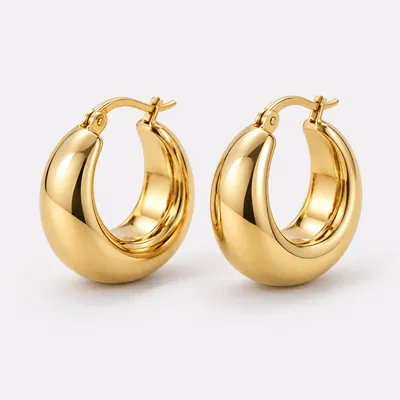
Types of Earrings: 9 Styles and How to Choose

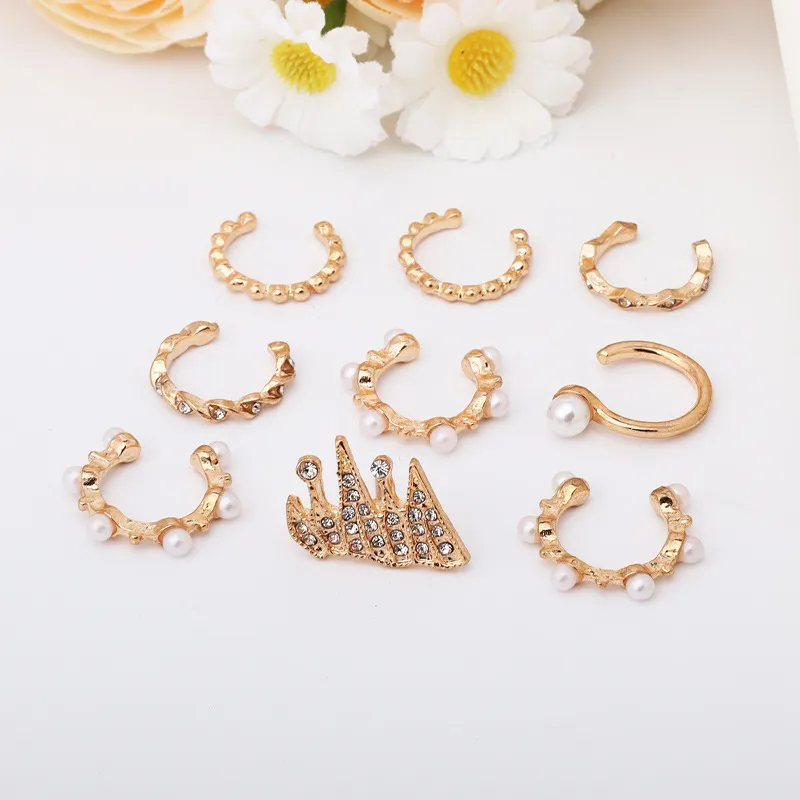
There are three main types of earrings: studs, which sit on the earlobe; hoops, which form a circle through it; and drops, which hang below it. Most other styles are variations on those three, such as huggies, front back earrings, ear climbers and tassels. Ear cuffs and clip-ons are for ears without a piercing in that spot.
This guide walks through nine styles you will see in shops, how each one is worn, and what to check in a listing before you buy. It is part of our jewelry size guide, which covers hoop sizes and earring post thickness.
Key Takeaways
- Studs, hoops and drops are the three core types. Most other earring styles are a version of one of them.
- Huggies are small hoops (about 0.4–0.6 in) that hug the earlobe, which makes them easy to wear all day and to stack.
- Ear cuffs and clip-on earrings need no piercing, so they work for unpierced ears or for adding a “second hole” look.
- Long, heavy drop earrings look dramatic but pull on the lobe. Save them for occasions rather than every day.
- Before buying, check three things in the listing: the size (hoop diameter or drop length), how it fastens, and what it is made of.
Earring types at a glance
| Type | How it’s worn | Best for |
|---|---|---|
| Stud | Sits flat on the earlobe, held by a back | Everyday wear and work |
| Hoop | A circle or semi-circle that passes through the lobe | Everyday to statement, depending on size |
| Huggie | A small, thick hoop that hugs the lobe | Daily wear, ear stacks |
| Drop and dangle | Hangs below the lobe from a hook or post | Parties, weddings, outfits with open necklines |
| Front back | One part in front of the lobe, one behind it | Evening looks, a modern twist on studs |
| Ear climber | Runs up the edge of the ear from the lobe | Ear stacks without extra piercings |
| Ear cuff | Clips around the outer ear, no piercing | Unpierced ears, festival and party looks |
| Clip-on | Clamps onto the lobe, no piercing | Unpierced ears, or resting a piercing |
| Earring set | Several pairs sold together | Mixing and matching, gifts, ear stacks |
Stud earrings
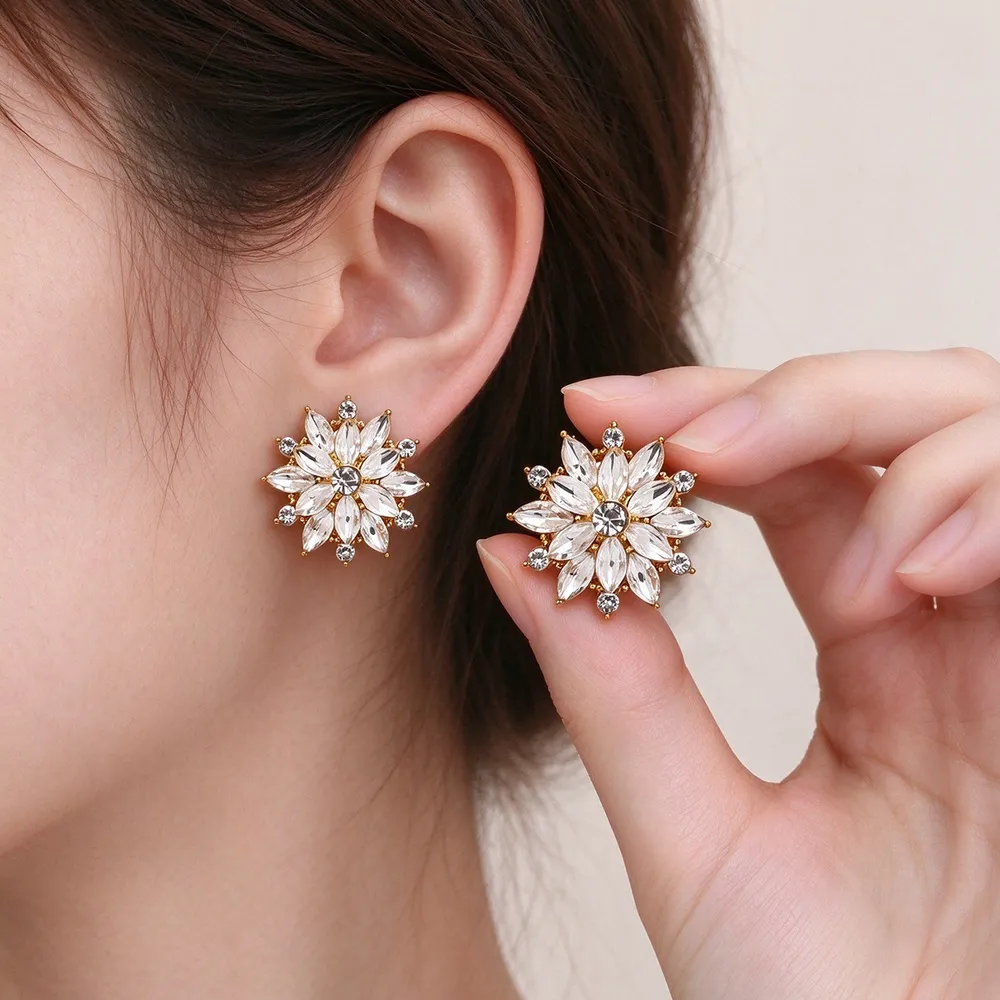
A stud sits directly on the earlobe. A straight post goes through the piercing and a back holds it in place behind the ear. Because nothing hangs or swings, studs are the easiest earrings to wear all day, under hats and headphones, and to work.
Studs range from a single dot of metal to larger flat designs that cover more of the lobe. The rhinestone snowflake flower studs are a typical everyday-to-evening pair. See all stud earrings.
Hoop earrings
A hoop is a ring of metal that passes through the piercing and closes with a hinge, a latch or a thin wire. Hoop size is usually given as the diameter; check whether a listing means the inside or outside measurement. Roughly:
- Small (under 1 in / 2.5 cm): subtle enough for every day.
- Medium (1–1.5 in / 2.5–3.8 cm): the classic everyday hoop.
- Large (over 1.5 in / 3.8 cm): a statement piece.
The large heart charm hoops are listed at 2 in (5 cm). Some hoops also carry charms or tassels: the snake and star tassel hoops reach 4.7 in (12 cm) from top to bottom. Browse hoop earrings.
Huggie earrings
Huggies are small, often chunky hoops that sit tight against the lobe, usually about 0.4–0.6 in (10–15 mm) across. Most close with a hinge, so there is no separate back to lose. Their small size makes them easy to wear all day, and they are the usual building block for an ear stack. The geometric mini huggie hoops come in 19 shapes, which makes it easy to mix several.
Drop and dangle earrings
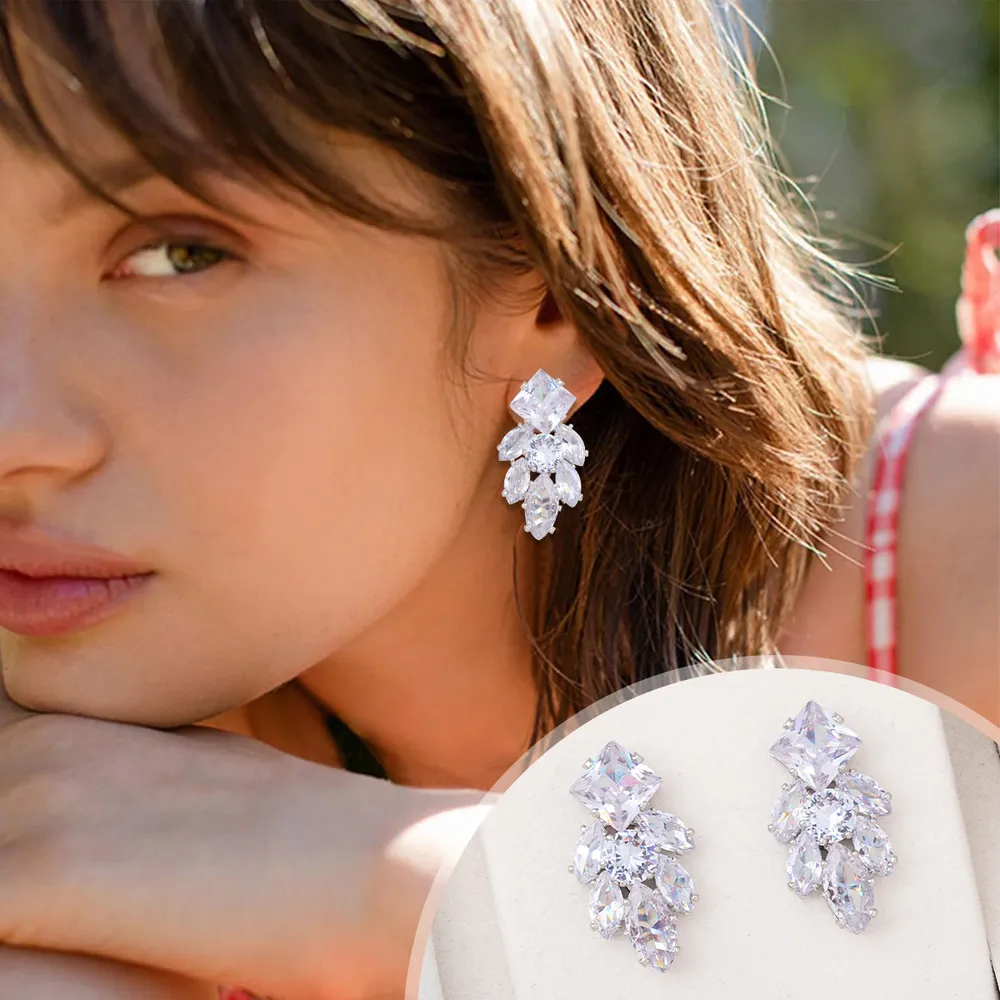
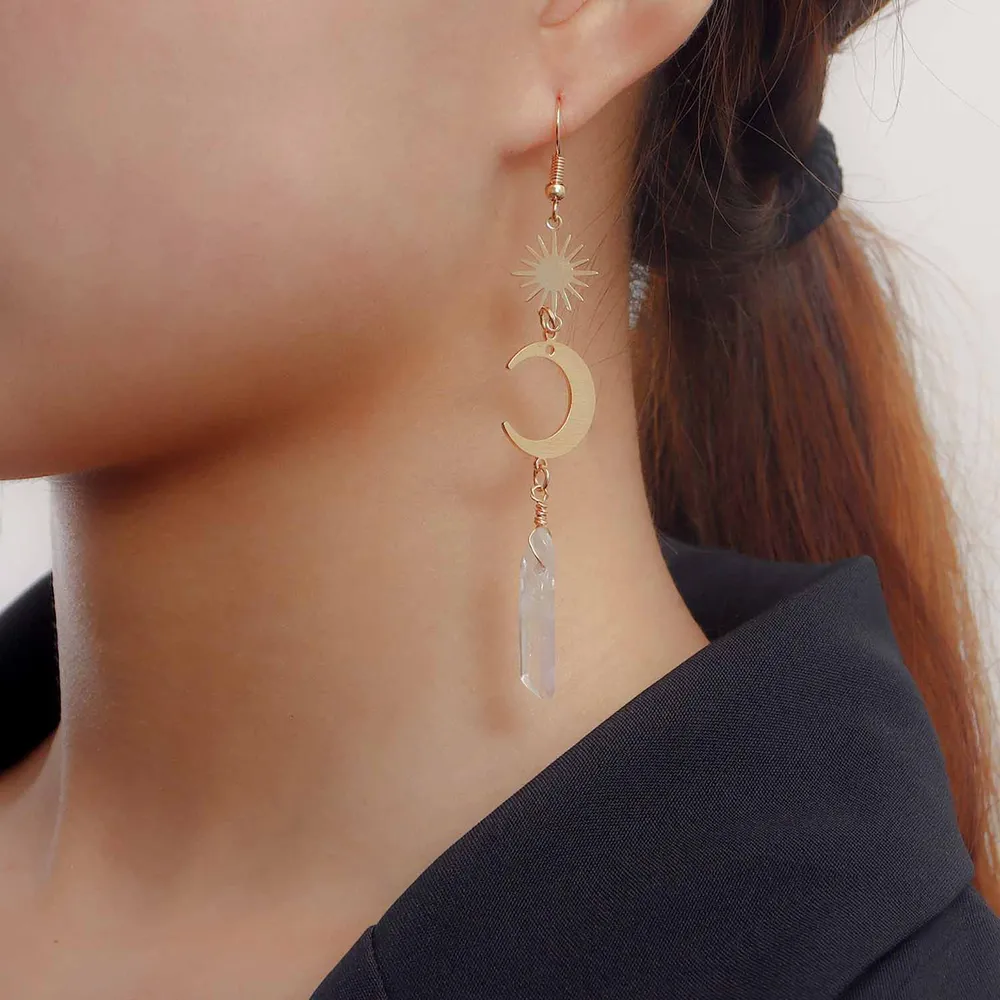
Drop earrings hang below the earlobe, either from a hook (a curved wire that passes through the piercing) or from a stud with a pendant attached. “Drop” and “dangle” are used almost interchangeably. Some shops use “drop” for a pendant that hangs still and “dangle” for one that moves, but there is no strict rule.
Common drop styles include:
- Teardrop: a single pear-shaped pendant.
- Tassel: strands of chain, beads or thread that swing as you move, from fine chains to beaded fringes.
- Threader: a fine chain or bar that you pull through the piercing so it hangs on both sides of the lobe.
- Chandelier: several tiers that widen toward the bottom.
- Bridal and statement drops: larger pieces with stones, such as the cubic zirconia bridal drops.
Weight is the one thing to watch. Cleveland Clinic notes that “[y]our earlobe size may increase if you wear heavy earrings” (Cleveland Clinic, last updated April 2025). Keep large, heavy drops for occasions and give your lobes a rest between wears. See all drop and dangle earrings.
Earring backs and closures
How an earring fastens matters as much as its shape, especially if you tend to lose backs.
- Butterfly (push) back: a small metal clutch that slides onto a straight post. The most common back on studs.
- Screw back: threads onto the post. More secure, slower to put on.
- Hook: an open curved wire (often called a fish hook or French hook) used on drops. A small stopper on the end keeps it from slipping out.
- Lever-back: a hinged hook that snaps shut behind the lobe, so it is much less likely to slip out.
- Hinge or latch: used on hoops and huggies; the hoop itself clicks closed.
If you keep losing backs, look for screw backs, lever-backs or hinged hoops.
Front back earrings
Front back earrings (sometimes called ear jackets) have two parts. A small stud shows on the front of the lobe, and a larger piece attaches to the post behind the ear, so it peeks out below. They look like a stud from one angle and a drop from another. The rhinestone crossover front back earrings measure 1.8 in (4.5 cm) from top to bottom.
Ear climbers
An ear climber goes through a normal lobe piercing, then follows the edge of the ear upward, so it looks like several earrings in a line. Climbers give you an ear-stack look with a single hole. Our bow and star ear climbers are a festive example.
Ear cuffs
An ear cuff wraps around the outer rim of the ear and stays on by gentle pressure, so no piercing is needed. Simple cuffs look like a cartilage hoop; others hold chains or tassels that hang down, like the crescent moon tassel ear cuff, which drops 3.5 in (9 cm). To put one on, slide it onto the thinnest part of the upper ear, then move it to where you want it and press it lightly closed.
Clip-on earrings
Clip-on earrings clamp onto the lobe with a hinged clip or a screw back instead of a post. They are the answer for unpierced ears, for anyone whose piercing has closed, and for days you want to rest a piercing. The faux turquoise clip-ons measure 0.9 in (2.4 cm). If you are sensitive to pressure, wear a new pair for short periods first. Browse clip-on earrings and ear cuffs.
Earring sets
Earring sets bundle several pairs or pieces, often mixing types: studs with huggies, or ear cuffs with small hoops. They are the easiest way to try styles you have not worn before, and they make simple gifts. The ear cuff and hoop set has 9 pieces for building a full ear stack, and other sets mix several pairs of drops or studs. See all earring sets.
What our earring catalog looks like
When we listed our earrings, we tagged each one by type. Of 103 earring styles in our catalog as of October 2026, drop earrings are the largest group, followed by studs and hoops:
Two patterns stood out. 4 of the 21 products in our hoop category (which also holds some huggies) carry a charm or tassel, so they sit somewhere between a hoop and a drop. And of the 10 earrings with “huggie” in the name, only 3 are typed as huggies; 6 are filed as hoops, because shops use both names for the same small hinged hoop. That’s why the size matters more than the name.
From Lumi: Before I write about an earring, I look for the size and the fastening, then the model photo. The question readers ask most about hoops is whether they will be too small, so I always look for the diameter. For clip-ons, it’s whether they pinch. If a listing doesn’t answer those, I hold off until it does.
How to choose the right type
- For every day and work: studs or huggies. Nothing catches on hair, scarves or headphones.
- For a night out or a wedding: drops, front backs or a statement hoop. Pair long earrings with a simple neckline.
- For an ear stack: a stud or huggie in the lobe, then a climber or ear cuff higher up.
- Without pierced ears: clip-ons for the lobe, ear cuffs for the outer ear.
- For a new piercing: stick with the studs your piercer used. The American Academy of Dermatology advises leaving starter earrings in for six weeks or more (AAD).
Whatever you choose, keep the posts clean. Our guide on how to clean earrings covers posts, backs and hinges.
Frequently asked questions
What are the three main types of earrings?
Studs, hoops and drops. Studs sit on the earlobe, hoops form a circle through it, and drops hang below it. Huggies, climbers, front back earrings and tassels are variations on these.
What is the difference between huggie and hoop earrings?
A huggie is a small hoop, usually about 0.4–0.6 in (10–15 mm), that sits tight against the earlobe and most often closes with a hinge. A regular hoop is larger and hangs more loosely.
Which earrings don’t need a piercing?
Ear cuffs and clip-on earrings. Ear cuffs grip the outer rim of the ear, and clip-ons clamp onto the earlobe.
What is the difference between drop and dangle earrings?
Very little. Both hang below the earlobe. Some shops call a pendant that hangs still a “drop” and one that swings freely a “dangle”, but the terms are mostly used interchangeably.
Find your style
Start with studs or huggies for every day, add drops or a statement hoop for occasions, and use cuffs or clip-ons if you don’t have a piercing in that spot. Check each listing’s size and fastening before you order, then browse all earrings by style.