Jewelry Size Guide & Chart: Necklaces, Bracelets, Rings & Anklets

To size jewelry at home you need a soft tape measure, or a strip of paper or string and a ruler. Measure the part of your body the piece goes around, then add a little room: about 2 in (5 cm) for a choker, 0.6–1 in (1.5–2.5 cm) for a bracelet, and about 1 in (2.5 cm) for an anklet. A ring is read straight from a chart.
From Lumi: I treat readers’ questions as a checklist. The same few come up again and again: will this hoop be too small, how different are 40 cm and 45 cm necklaces, can this bracelet be adjusted, and will clip-ons pinch? That’s why each sizing section below starts with how to measure, not with what’s trending.
This page gathers our quick jewelry size charts in one place. Each section links to a full guide where we have one. All lengths are in inches first, with centimeters in brackets (1 in = 2.54 cm).
Key Takeaways
- Necklaces: 16 in sits at the base of the neck, 18 in on the collarbone, and 20–24 in falls from below the collarbone to the top of the bust.
- Bracelets: measure your wrist just below the wrist bone and add about 0.6 in (1.5 cm) for a snug fit or 1 in (2.5 cm) for a loose one.
- Rings: measure around the base of your finger and match the result to the chart. More than half of our rings are adjustable.
- Anklets: measure just above the ankle bone and add about 1 in (2.5 cm) so the anklet can move.
Necklace sizes
For a choker, measure around your neck and add about 2 in (5 cm). For longer necklaces, use the chart to pick where you want it to sit.
| Length | Where it sits |
|---|---|
| 14 in (35.6 cm) | Snug around the neck (collar) |
| 16 in (40.6 cm) | Base of the neck (choker) |
| 18 in (45.7 cm) | On the collarbone, the most common length |
| 20 in (50.8 cm) | Just below the collarbone |
| 24 in (61.0 cm) | At the top of the bust |
| 30–36 in (76–91 cm) | Below the bust, or doubled |
Jewelers such as Brilliant Earth call 18 in the most common length. Necklace length includes the clasp, and an extender adds 2–4 in (5–10 cm). For neckline matching, layering gaps and men’s lengths, read the full necklace length guide and chart. To tell cable, snake, box and other chains apart, see our guide to types of necklace chains. Shop by length in necklaces, from chokers to layered styles.
Bracelet sizes
Wrap a soft tape or a strip of paper around your wrist just below the wrist bone, where a bracelet sits, mark where it meets, and measure it flat. Then add room for the fit you like. For example, a 6.3 in (16 cm) wrist takes a 6.9 in (17.5 cm) bracelet for a snug fit or 7.3 in (18.5 cm) for a loose one.
| Wrist size | Snug fit | Loose fit |
|---|---|---|
| 5.5 in (14 cm) | 6.1 in (15.5 cm) | 6.5 in (16.5 cm) |
| 5.9 in (15 cm) | 6.5 in (16.5 cm) | 6.9 in (17.5 cm) |
| 6.3 in (16 cm) | 6.9 in (17.5 cm) | 7.3 in (18.5 cm) |
| 6.7 in (17 cm) | 7.3 in (18.5 cm) | 7.7 in (19.5 cm) |
| 7.1 in (18 cm) | 7.7 in (19.5 cm) | 8.1 in (20.5 cm) |
| 7.5 in (19 cm) | 8.1 in (20.5 cm) | 8.5 in (21.5 cm) |
As of October 2026, the two most common lengths among our bracelets with a listed length are 7.1 in (18 cm) and 6.7 in (17 cm). By the chart above, those fit a wrist of about 5.7–6.5 in (14.5–16.5 cm). Stretch bracelets fit most wrists, and cuffs can be bent gently to size.
Bangles have no clasp, so they must slide over your hand. Bring your thumb and little finger together as if putting a bangle on, measure around the widest part of your hand, and choose a bangle with an inner circumference at least that size. For the full chart, extenders and bangle sizes, see our bracelet size chart, or browse bangles and cuffs.
Ring sizes
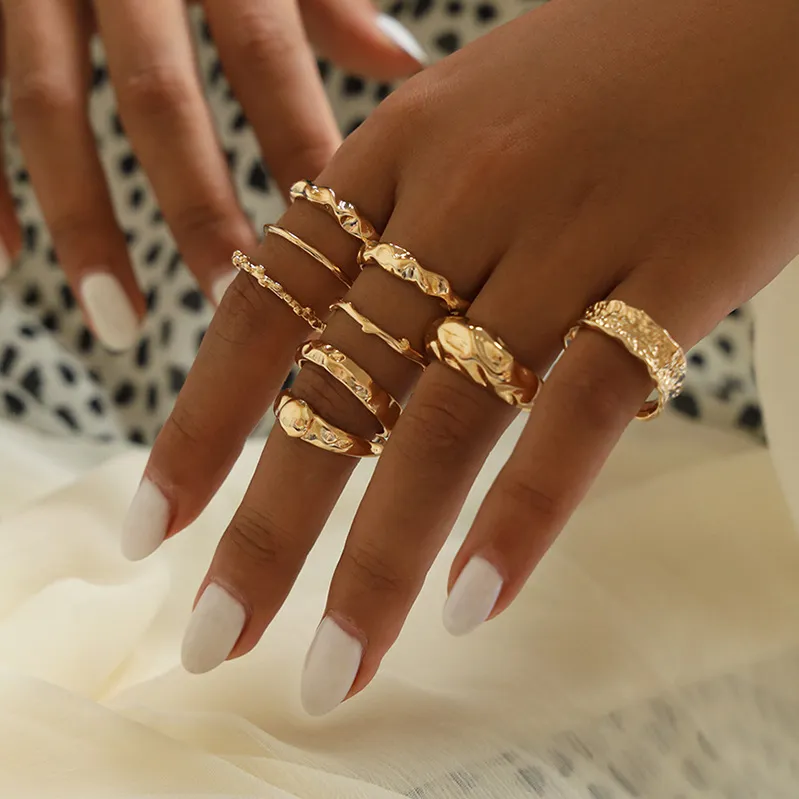
Wrap a thin strip of paper around the base of your finger, mark where it overlaps, and measure the length in millimeters. That is your inner circumference. Find the closest value below. If you fall between two sizes, choose the larger one. For styles such as stackable, knuckle and open rings, see our guide to types of rings.
| US size | Inner diameter | Inner circumference | UK / AU | EU |
|---|---|---|---|---|
| 5 | 0.62 in (15.7 mm) | 49.3 mm | J ½ | 49 |
| 6 | 0.65 in (16.5 mm) | 51.8 mm | L ½ | 52 |
| 7 | 0.68 in (17.3 mm) | 54.3 mm | N ½ | 54 |
| 8 | 0.71 in (18.1 mm) | 56.9 mm | P ½ | 57 |
| 9 | 0.74 in (18.9 mm) | 59.4 mm | R ½ | 59 |
| 10 | 0.78 in (19.8 mm) | 62.2 mm | T ½ | 62 |
The international standard, ISO 8653:2016, designates ring sizes by this inner circumference in millimeters, which is why EU sizes match the millimeter column. Measure at the end of the day when your hands are warm. Fingers are slightly smaller in the morning and in cold weather.
If you don’t know your size, an open ring is the easy answer. As of October 2026, 31 of the 60 rings in our catalog are adjustable. See adjustable rings and stackable ring sets.
Anklet sizes
Measure around your ankle just above the ankle bone, then add about 1 in (2.5 cm) so the anklet can move and sit on the bone rather than above it. The two most common lengths among our anklets are 8.3 in (21 cm) and 8.7 in (22 cm). By the same rule, those fit an ankle of about 7.3–7.7 in (18.5–19.5 cm). If your ankle is larger, look for a longer extender or an adjustable slider style. Our anklet size guide has a full chart and more on extenders.
Leg chains, thigh chains and shoe chains are measured differently. A leg chain is listed by its full length from the ankle to the toe or calf. A thigh chain is sized by thigh circumference, so read each listing’s measurement against your own. Browse leg chains to compare lengths.
Earring sizes
Earrings don’t need a body measurement, but three numbers still matter. For what each style looks like, see our guide to types of earrings; for how each one fastens, see types of earring backs.
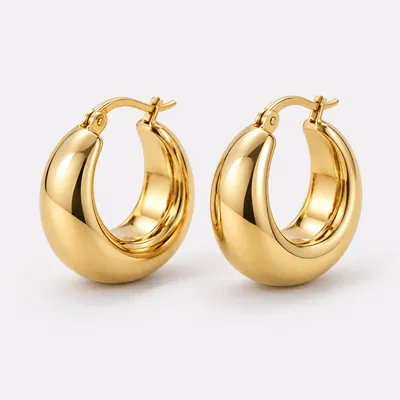
- Hoop size is usually listed as the outer diameter; some huggies list the inner diameter, so check the listing. A huggie is about 0.4–0.6 in (10–15 mm) and hugs the lobe; 1–1.5 in (25–38 mm) is an everyday hoop; 2 in (50 mm) and larger is a statement hoop.
- Drop length is from the top of the earring to the bottom. Under 1 in (2.5 cm) stays near the lobe; over 2 in (5 cm) swings toward the jaw.
- Post thickness (gauge) matters if your piercings are small. Earring posts are commonly 20G (0.8 mm) or 18G (1.0 mm). The higher the number, the thinner the post.
No piercing? Clip-on earrings and ear cuffs don’t need one. If you’re sensitive to pressure, wear a new clip-on pair for short periods first, and check whether the listing says the clip is adjustable. Keeping posts and hooks clean matters as much as the size; our guide on how to clean earrings covers posts, backs and hinges.
Frequently asked questions
How do I measure my size without a tape measure?
Use a strip of paper, a phone charger cable or a piece of string. Wrap it around the wrist, finger, ankle or neck, mark where it meets, then lay it flat next to a ruler.
What if I’m between two sizes?
For rings, go up a size. For bracelets and anklets, choose the larger size or a style with an extender. For necklaces, pick the shorter chain if it has an extender, since an extender adds length but can’t take it away.
Are jewelry sizes the same in the US and Europe?
Lengths are the same and are only converted between inches and centimeters. Ring sizes differ: a US 7 is a UK N½ and roughly an EU 54. Use the inner circumference in millimeters to compare across systems.
Start with the piece you’re buying
Measure once, add the right amount of room, and check the length line in each listing, including any extender. Where a listing gives a length, it shows both inches and centimeters, so you can compare it with these charts. If a size isn’t clear, email us at support@dazzlot.com before you order, or read more about Dazzlot. Then browse by category from the menu.